Mappings
Mapping specifications provide a way to create one-directional alignments between two models. They allow you to document how e.g. elements from one message model relate to elements in another message model, which is essential for interoperability and data transformation scenarios.
Mappings are particularly useful when you need to:
- Document how data from one standard maps to another
- Enable data transformation between different message models
- Compare and align specifications from different domains or organizations
- Track the relationship status between elements across specifications
Creating a mapping specification
To create a mapping specification:
- Navigate to the Specifications screen
- Click the '+' icon in the top right corner
- Select Mapping from the dropdown menu
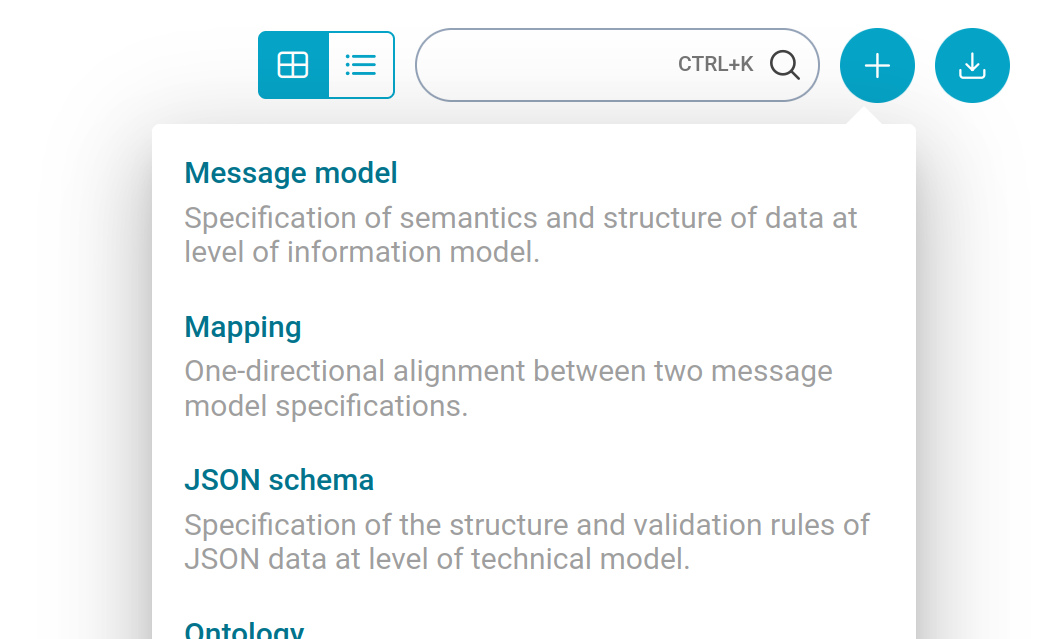
This will create a new mapping specification. Like other specification types, you'll need to:
- Fill in the general specification fields (name, title, project, description, etc.) as described in Manage specifications
- Create a specification version to hold the actual mapping content
Configuring the mapping
After creating a mapping specification and version, you can configure the mapping by editing the version. The Mapping tab allows you to specify:
- Source specification: The model that you want to map
- Target specification: The model you want to map to
Both source and target must be specifications available to you in the same Semantic Treehouse environment.
The mapping configuration screen also includes standard tabs for version management, release notes, documentation, and acknowledgements, as described in Manage specifications.
Creating mapping items
A mapping specification consists of several mappings describing which elements from the source and target specifications relate to each other, and how.
Mappings can be created and managed through the canvas interface when viewing a mapping specification. The canvas provides a visual representation of the mapping, showing:
- The source and target models
- All element mappings between them
- Progress indicators showing mapping status
- Search and filtering capabilities
Switch the mapping to edit mode, then drag an element from the source to the target element to create a mapping.
Mapping properties
Each mapping has several properties that describe the relationship:
Status
The status indicates the current state of the mapping:
- Final: The mapping is complete and verified
- Proposal: A suggested mapping that requires discussion
- Missing Info: The mapping needs additional information to be completed
Predicate
The predicate describes the type of relationship between the source and target elements, using SKOS (Simple Knowledge Organization System) vocabulary:
- skos:exactMatch (=): The elements can be used interchangeably with high confidence
- skos:closeMatch (≈): The elements are sufficiently similar to be used interchangeably in some cases
- skos:broadMatch (⊂): The source element relates to a more generic concept in the target
- skos:narrowMatch (⊃): The source element relates to a more specific concept in the target ö- skos:relatedMatch (~): An associative relationship between the elements (this is the default if no predicate is specifieöd)
- custom:noEquivalent (≠): No equivalent exists in the target (explicit 1:0 mapping, exported as
owl:differentFromin RDF)
Justification
The justification indicates how the mapping was created or determined:
- semapv:ManualMappingCuration: A human expert manually reviewed and created this mapping
- semapv:LexicalMatching: Based on string/label similarity (e.g., "Invoice" matches "Invoice")
- semapv:LogicalReasoning: Inferred through ontology reasoning or inference rules
- semapv:SemanticSimilarityThresholdMatching: Automated semantic analysis (e.g., embeddings, machine learning, or LLM-based matching)
Annotations
Annotations provide additional context or notes about the mapping. You can add multiple annotations to document:
- Differences between the elements
- Transformation rules or considerations
- Usage notes or constraints
- Any other relevant information about the mapping relationship
Exporting mappings to SSSOM
Mappings can be exported to SSSOM (Simple Standard for Sharing Ontological Mappings) format for interoperability with other tools and systems.
To export a mapping, click the download icon on the mapping specification page.
Exporting mappings to Excel
A simple three-column export can be made from the mapping specification page by clicking the Export icon and selecting the Spreadsheet option. It includes source item, predicate (e.g. closeMatch, exactMatch, noEquivalent) and target
Export formats
The following RDF formats are supported:
| Format | Extension | Description |
|---|---|---|
| RDF/Turtle | .ttl | Default format, standard semantic web serialization |
| RDF/XML | .rdf | Alternative RDF serialization |
| JSON-LD | .jsonld | JSON-based RDF serialization |
API access
The export is available via the API with optional format selection:
/api/mapping/-/version/{id}/export/sssom(defaults to Turtle format)/api/mapping/-/version/{id}/export/sssom?format=turtle/api/mapping/-/version/{id}/export/sssom?format=rdfxml/api/mapping/-/version/{id}/export/sssom?format=jsonld
Mappings are always included in the export. If no predicate is explicitly set, the default predicate skos:relatedMatch is used. If no justification is set, the default semapv:ManualMappingCuration is used.